
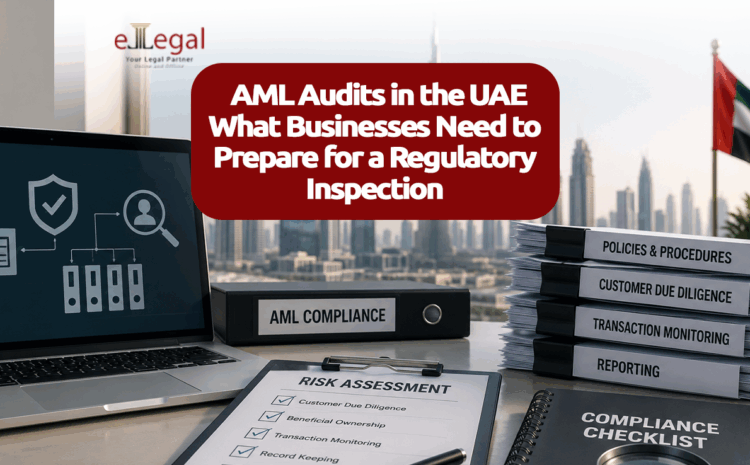
The authorities in their bid to combat financial crimes have intensified their efforts on particularly money laundering and terrorism financing, while safeguarding the stability and integrity of both national and international economies. To foster awareness and enforce rigorous implementation of anti-money laundering measures, the AML supervisory authorities in the UAE including the Ministry of Economy, Ministry of Justice, and ADGM’s Financial Services Regulatory Authority have initiated comprehensive inspections to evaluate the quality and effectiveness of entities’ AML efforts and their overall regulatory compliance status.
In this blog, we will be exploring the critical importance of AML inspections and provides strategic guidance on effectively responding to inspection notices issued under the UAE AML regulations.
Understanding AML Inspections
As previously mentioned, AML inspections represent a fundamental supervisory tool employed by regulatory authorities to assess regulated entities’ adherence to AML compliance UAE requirements. Beyond mere assessment, these inspections serve as a powerful mechanism that enables authorities to identify deficiencies within the government’s legislative framework, facilitating immediate remedial actions and detecting emerging money laundering and terrorism financing vulnerabilities within the country.
AML inspections demonstrate the government’s unwavering commitment to combating financial crimes. Regulated entities are expected to mirror this same dedication toward AML compliance UAE standards. Consequently, these inspections send a clear signal that authorities are proactively monitoring business operations and AML efforts.
These inspections enable regulatory authorities to evaluate the AML health of businesses, provide guidance for improving protective measures, and ensure the financial integrity of both individual entities and the broader national financial system.
How to be Prepare and be Ready for AML Inspection
AML compliance is not a stopgap arrangement where Compliance Officers make last-minute efforts to develop programs and compile documentation merely to satisfy inspection requirements. Rather, regulated entities must maintain a state of perpetual inspection readiness. This is achievable through a well-crafted AML Policy UAE framework that is consistently followed by every employee during regular business operations, ensuring protection against potential financial crime threats while adhering to legal obligations.
Regulated businesses should consider the following essential elements to remain compliant and inspection-ready:
Maintaining Robust AML/CFT Policies, Procedures, and Controls
Entities must develop customized AML/CFT policies and controls tailored to manage their assessed exposure to financial crime. This framework must align with applicable UAE AML regulations and relevant laws. The AML program should undergo periodic reviews to evaluate its effectiveness in identifying and mitigating risks, helping the entity identify policies or procedures requiring immediate attention.
Conducting Regular AML Compliance Reviews
The AML Compliance Officer should regularly examine the comprehensiveness and quality of the entity’s AML measures and deployed controls. This review should encompass Customer Due Diligence processes, ongoing monitoring programs, and the identification and reporting of suspicious transactions. Such reviews enable the Compliance Officer to detect compliance instances or AML gaps, offering guidance for enhancing necessary measures, implementing new controls, or upgrading existing systems.
Ensuring Adequate AML Record Keeping
The resources invested in AML compliance can only be substantiated when documentation is presented to authorities in a legitimate and easily understandable manner. Well-organized records and information can be promptly made available to inspecting authorities when requested. Immediate submission of requested documents demonstrates the entity’s ongoing AML activities and dedication to combating financial crime.
Effectively Responding to an AML Inspection Notice
Observations indicate that UAE AML supervisory authorities typically issue inspection notices via registered email, generally addressed to the AML Compliance Officer of the regulated entity. The notice contains critical information regarding the inspection officer, expected inspection date, records and documents required for desk review, and materials that must be readily available during on-site visits. The team must respect and adhere to the timelines and data requests specified in the inspection notice.
The quality of the response to the inspection notice and the level of clear, transparent communication with authorities reflect the entity’s commitment to AML compliance UAE obligations.
The following steps should be followed to respond effectively to an AML inspection notice:
- Designating an Inspection Response Team
The regulated entity must identify a responsible person to manage the inspection—ideally the AML Compliance Officer, assisted by team members with adequate AML knowledge. Senior management must be informed about the proposed inspection. If necessary, assistance from third-party AML professionals and compliance officer services UAE providers should be sought to avoid misinterpretation of the notice and ensure a response that satisfies authorities.
- Understanding Scope and Requested Information
The AML Compliance Officer must thoroughly review the inspection notice and map its requirements against the entity’s records. Understanding the inspection scope helps the Compliance Officer identify the areas authorities intend to review and the information to be furnished.
- Collating Information and Drafting the Response
The AML Compliance Officer should begin collecting and organizing requested information in one central location. Documents and information must be arranged systematically to facilitate the authorities’ review process. Responses to questions in the inspection notice must be adequately captured with explicit references to any attachments.
Best Practices for a Smooth AML Inspection:
Restrict Document Submission: Only provide documents specifically requested. Dumping unnecessary files may confuse authorities and complicate inspection conclusion.
Cross-Reference Documentation: Ensure clear cross-referencing with serial numbers mentioned in the data request and submitted files.
Proper File Naming: Name files and folders appropriately to enable authorities to easily identify required data sets.
Timely Submission: Avoid unnecessary delays. Once all requested details are arranged, share them promptly with inspecting officers.
- On-Premise Inspection
Authorities may choose to physically visit the regulated entity’s office to gain firsthand experience with implemented AML measures. If requested, the Compliance Officer must demonstrate the systems and controls in place. The entity must also ensure employees are available and prepared to answer AML questions posed by inspecting officers during interviews.
Conclusion
AML inspections are a vital component of the UAE’s comprehensive approach to combating financial crimes. By maintaining robust AML frameworks, ensuring readiness, and responding effectively to inspection notices, regulated entities can demonstrate their commitment to AML compliance UAE while protecting themselves from regulatory penalties and reputational damage.
Engaging professional compliance officer services UAE can provide valuable support in navigating the complexities of UAE AML regulations, ensuring that entities remain compliant and inspection-ready at all times. Ultimately, a proactive approach to AML compliance not only satisfies regulatory requirements but also contributes to the stability and integrity of the UAE’s financial system. Contact us for a free consultation today.