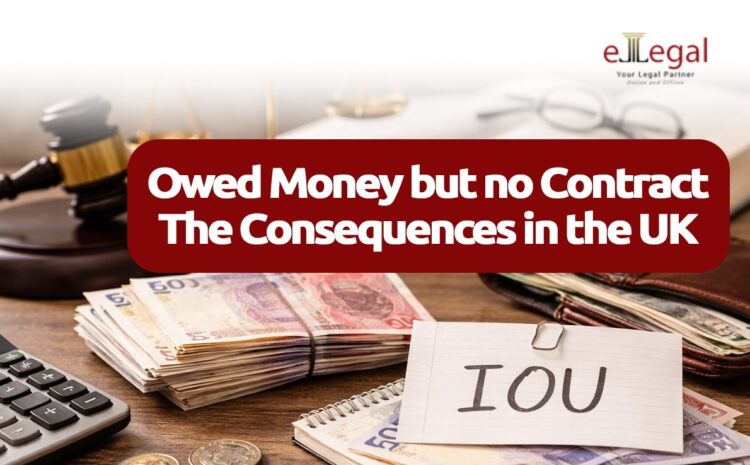
When you are owed money, hindsight is a powerful thing. In the rush to complete a business transaction or help a friend, formalizing the arrangement with a legally binding agreement is often overlooked. We tend to assume that because we intend to uphold our end of the deal, the other party will do the same which often time than not does not end up well.
However, if payment fails to materialize and a dispute arises, you may need to consider your legal options. The success of any legal action to recover the debt will hinge almost entirely on the evidence you can provide to prove the money is owed.
This guide outlines the legal principles surrounding verbal agreements, the types of evidence that can support your claim, and the steps involved in pursuing the money you are owed in the UK.
Are Verbal Agreements for Money Owed Enforceable?
A common misconception is that a contract must be a signed written document which in reality, contracts can be formed verbally between parties.
While a written agreement outlining the financial terms is always preferable, a legally binding contract may still exist if the essential elements were covered in a conversation.
Generally, for a contract to be valid under UK law, the following principles must be met:
- Offer: One party makes a clear offer (e.g., “I will lend you £200 for two weeks” or “I will complete this work for you for £500”).
- Acceptance: The other party clearly agrees to the offer.
- Consideration: Both parties exchange something of value (e.g., money, a service, or goods). In a loan, the money itself is the consideration; in a service agreement, it is the work for the fee.
- Intention to Create Legal Relations: Both parties intended the agreement to be enforceable by law. This is generally presumed in business contexts but can be harder to prove in social or domestic arrangements.
- Capacity: Both parties have the legal ability to enter a contract (e.g., they are over 18 and of sound mind).
If these elements were present in a verbal discussion, a contract has likely been formed and binding on both parties where if the terms are then breached, you may have grounds to take legal action.
The Importance of a Written Agreement
While it is possible to enforce an oral agreement, having a solid written contract from the outset eliminates ambiguity. This is where professional contract drafting UK services become invaluable.
But what is contract drafting? It is the process of creating a legally binding document that clearly outlines the obligations, deliverables, and payment terms agreed upon by the parties. A well-drafted contract acts as a roadmap for the relationship and a safety net if things go wrong. While you might wonder, can anyone draft a contract, the reality is that DIY agreements often miss crucial clauses or contain ambiguities that lead to disputes. Investing in a properly drafted contract is always more cost-effective than litigating later.
Can You Take Someone to Court for Owing You Money?
Yes, you can. However, court should always be considered a last resort. Before issuing a claim, you are generally expected to follow a pre-action protocol, which includes:
- Sending a formal “Letter Before Action” to the debtor, outlining the amount owed and giving a clear deadline for payment.
- Attempting to negotiate or mediate a settlement which is often the best.
If these steps fail, you can issue a claim. As the Claimant, the burden of proof lies with you. You must convince the court, on the balance of probabilities (i.e., that it is more likely than not), that the debt is real and enforceable.
A judge’s final decision will be based on:
- The applicable law (usually breach of contract).
- The evidence you provide.
- The evidence provided by the defendant.
- The balance of probabilities.
What Evidence Can You Use If There Is No Written Contract?
The absence of a signed contract does not mean your case is hopeless. Courts rely on a wide range of evidence to establish whether a debt exists. Here are the most valuable types of proof you can gather.
- Bounced Cheques or Returned Direct Debits
Though less common today, a cheque is considered a “promise to pay” in law. If a debtor gave you a cheque that bounced or set up a direct debit that was later returned, this serves as a powerful admission that a debt was acknowledged and intended to be paid.
- Unpaid Invoices and Statements
In a business context, invoices are a standard way of requesting payment. Even without a signed contract, providing copies of unpaid invoices, along with proof they were sent to the customer, is strong evidence of an outstanding debt.
Furthermore, if you regularly sent statements showing the amounts owed and highlighting overdue sums, and the debtor did not object to them at the time, these can also be used to support your claim.
- Evidence of Chasing the Debt
Your communications with the debtor can become your strongest evidence. Save all correspondence related to the debt, including:
- Emails
- Letters
- Text messages
- Social media messages (Facebook, WhatsApp, LinkedIn, etc.)
If the debtor has ever responded by apologizing, promising to pay “next week,” or asking for more time, this is an admission of liability. It proves they acknowledge the debt exists, even if they are now disputing it. Be sure to take screenshots of digital conversations in case they are deleted.
- Proving a Loan to Friends or Family
Proving a loan to someone you know personally can be more complex, as money given in these contexts can sometimes be interpreted as a gift. To establish that the money was a loan, you should gather evidence showing the intention was for it to be repaid, such as:
- Bank statements showing the transfer of funds to the individual.
- Bank statements showing previous repayments being made, which have now stopped.
- Your financial history, to demonstrate that a large, non-repayable gift would be out of character or unaffordable given your income and outgoings.
- Any messages where the terms “loan,” “borrow,” or “pay you back” were used.
- Witnesses to the Arrangement
If there is little to no documentation, an independent witness to the verbal agreement can be invaluable.
In a business context, did an employee hear the customer agree to the price over the phone?
In a personal context, was a friend present when the terms of the loan were discussed?
If an independent witness is not available, you can still provide your own version of events in a written witness statement. Should the case go to a hearing, any witnesses may be required to attend court to give evidence.
Conclusion
Recovering money without a written agreement presents challenges, but it is far from impossible. By gathering all available evidence from bank records and bounced payments to emails and witness testimony you can build a compelling case to prove the debt exists.
If the other party disputes the claim, the matter may ultimately need to be settled in court. Given the complexities of contract law in the UK and the importance of presenting your evidence correctly, obtaining professional legal advice is a critical first step.
We at eLegal Consultants can assess the strength of your evidence and guide you on the best course of action to recover the money you are owed. Contact us today for a free consultation.