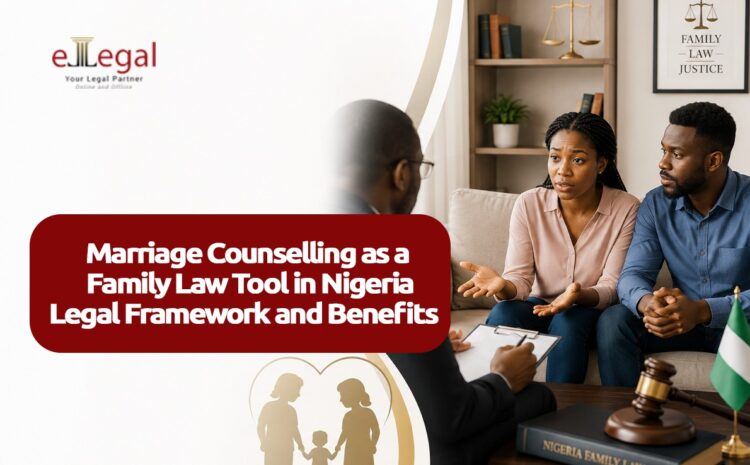
Marriage which is considered to be a sacred institution is celebrated with great joy and the expectation of a lifelong partnership between the parties. However, when unresolved conflicts or a breakdown in the marriage arise, the emotional and legal consequences can be overwhelming. In Nigeria, family law provides a structured framework for addressing marital disputes, yet the journey need not always begin in a courtroom as there are alternative and better means. Marriage counselling before litigation is not merely a recommended step but rather a powerful tool that can preserve relationships, protect families, and reduce the emotional and financial toll on both parties.
This blog explores the interplay between family law in Nigeria and the role of marriage counselling, highlighting the benefits of seeking professional guidance before rushing to litigation. It also examines how engaging a family lawyer in Nigeria can complement the counselling process, ensuring that your rights are protected whether you are navigating marriage dissolution Nigeria or seeking the advice of a divorce lawyer Nigeria.
Legal Framework For Marriage Counselling
The Matrimonial Causes Act 1970
The dissolution of statutory marriage in Nigeria is a complex and sensitive issue governed principally by the Matrimonial Causes Act (MCA) of 1970. The Act provides for divorce, judicial separation, custody of children, maintenance, and settlement of property. Jurisdiction under the Act lies exclusively with the High Court of a State.
What sets Nigerian matrimonial law apart is its deliberate and principled emphasis on reconciliation which sets to protect the sanctity of marriage and is never in a hurry to dissolve a marriage. Dissolution of marriage (divorce) is not by mere signature—it is a judicial process that requires the court to first consider whether the marriage can be saved.
The Role of Marriage Counselling Before Litigation
Marriage counselling serves as a critical first line of defence against the breakdown of marital relationships. Its role before litigation can be summarised in the following ways:
Facilitating Communication
A major cause of marital disputes in Nigeria is poor communication. Counselling provides a safe environment where couples can express their feelings, listen to each other, and learn effective communication strategies.
Identifying Root Causes of Conflict
Many couples rush to file for divorce without fully understanding the underlying issues driving their dissatisfaction. A marriage counsellor can help identify patterns of behaviour, unresolved grievances, and external pressures that may be contributing to marital distress.
Exploring Alternatives to Divorce
Counselling opens the door to alternatives such as judicial separation, restitution of conjugal rights, or simply a trial separation. Couples may discover that their marriage is salvageable once they address the root causes of their unhappiness.
Preparing for an Amicable Separation
Even when reconciliation is impossible, counselling can help couples separate amicably. Mediation, a form of counselling, allows couples to negotiate custody, property division, and maintenance in a collaborative manner, reducing the hostility that often characterises litigation.
Court-Referral Mechanisms
The court may refer a couple to a marriage counsellor or mediator to attempt reconciliation before proceeding with divorce. This referral is not merely procedural but reflects the court’s active commitment to preserving marriages where possible. The court may also set up mediation and appoint conciliators for the reconciliation process.
Benefits of Marriage Counselling Before Litigation
The advantages of pursuing counselling before litigation extend far beyond the emotional realm. Here are the key benefits:
Cost Savings
Litigation is expensive. Court filing fees, lawyer retainers, expert witness fees, and the cost of time away from work can quickly escalate. Counselling and mediation are significantly more affordable and can often resolve disputes in a matter of weeks rather than months or years. By resolving conflicts early through counselling, parties can avoid the substantial financial burden of full-scale litigation.
Time Efficiency
The Nigerian judicial system is notoriously slow. A contested divorce can take several years to conclude. Mediation, by contrast, can be completed in a few sessions, allowing couples to move forward with their lives more quickly.
Emotional Wellbeing
Litigation is adversarial by nature, often exacerbating conflict and deepening emotional wounds. Counselling provides emotional support, stress management techniques, and problem-solving skills. It helps couples process their emotions in a constructive environment rather than through the combative lens of courtroom proceedings.
Preservation of Family Relationships
Family disputes, particularly those involving children, benefit enormously from a less adversarial approach. Counselling helps preserve familial relationships and ensures outcomes that are more tailored to the interests of the parties, especially in matters involving children and shared property. When parents can communicate effectively and resolve conflicts amicably, children are spared the trauma of witnessing bitter parental warfare.
Confidentiality
Unlike court proceedings, which are matters of public record, counselling and mediation are confidential. This privacy allows couples to address sensitive issues without public exposure and protects the dignity of all parties involved.
Higher Compliance Rates
Parties who reach agreements through counselling and mediation are more likely to comply with those agreements voluntarily. Court-imposed orders, by contrast, often face resistance and require enforcement mechanisms, leading to further litigation and expense.
Conclusion
Marriage counselling as a family law tool in Nigeria is not merely a procedural formality—it is a substantive legal mechanism embedded in the Matrimonial Causes Act and supported by judicial practice. Section 11 of the Act places a positive duty on courts to pursue reconciliation, while Sections 14 and 17 provide the framework for confidential, good-faith efforts to save marriages.
The benefits of pursuing counselling before litigation are undeniable: cost savings, time efficiency, emotional wellbeing, preservation of family relationships, confidentiality, and higher compliance rates. These advantages make counselling an invaluable tool not only for couples seeking to save their marriages but also for those who ultimately proceed to marriage dissolution Nigeria.
For anyone navigating these challenging waters, engaging a family lawyer in Nigeria or a divorce lawyer Nigeria early in the process is essential. Legal counsel can complement the counselling process, protect your rights, and ensure that whether you reconcile or proceed to dissolution, your interests are safeguarded.
Marriage counselling, as a family law tool offers couples a path to resolution that honours the sanctity of marriage while respecting the dignity and rights of all parties involved. You can reach out to us for a free consultation today.